WHEN SCIENCE & GAMING MEET,
Good things happenWe at PlayAblo believe that education – when holistic in nature – develops in children a strong understanding of theoretical concepts as well as knowledge to apply these concepts in real life. It is the journey from Lower Order Thinking Skills to Higher Order Thinking Skills, which helps children master even the most complex concepts through the development of a scientific temper, a sense of curiosity and the power of critical thinking.
This scientific structuring of cognitive skills, known the world over as Bloom’s Taxonomy, is used by educators to aid and map learning goals. At Playablo, we define the cognitive skills not just at taxonomy level but tie them with the depth of understanding required to hone the skill. We blend the strengths of Bloom’s Taxonomy and Webb’s Depth of Knowledge Model into the cognitive journey through our assessments. The assessments are not just a string of questions but each individual question persuades a child to examine learning outcomes in varied perspectives.
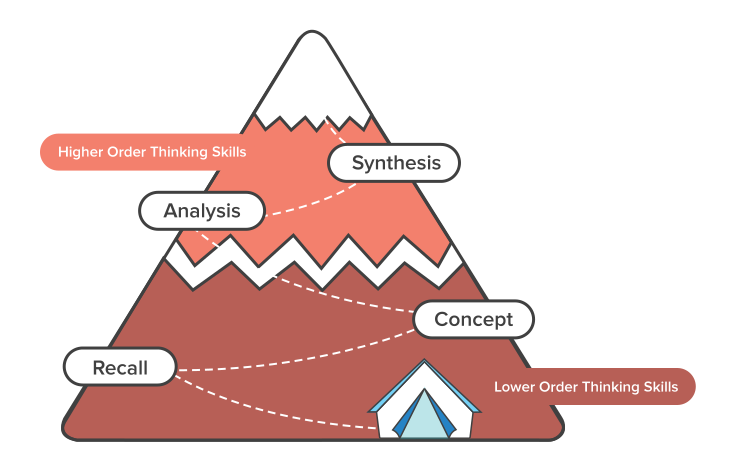
PlayAblo’s assessment levels include the following:
- 01
- 02
- 03
- 04
Recall
The questions in Level 1 are designed to prompt recall of previously learnt material - from simple facts and basic concepts, to step-by-step procedures. The simple and straight forward answers involve the lowest level of cognitive thinking.
For example:
What are the units used to measure length?
- A. cm
- B. ml
- C. kg
- D. mg
Concept
The questions in this level help the child understand facts and ideas by organizing, comparing, estimating, interpreting, and making basic inferences.
Solving problems by applying knowledge acquired in a context different from the one in which it was learned, the child demonstrates mid-level cognitive thinking.
For example:
Convert centimeters into meters. 1500 cm = ________ m
- A. 15
- B. 150
- C. 16
- D. 590
Analysis
Planning, reasoning and sequencing are some of the skills that children develop while answering questions in this level. By integrating the knowledge and skills acquired across multiple concepts and subjects, the child is encouraged to arrive at the right answer through analysis and strategic thinking.
For example:
Myra has a stick which is 250 centimeters long. Jiya has a stick which is 2 meters long. Who has the longer stick?
- A. Myra
- B. Jiya
Synthesis
The answers to questions in this level require comprehensive understanding of the problem and its various aspects and connecting the dots across multiple subjects/concepts to come up with the solution. This level serves to prepare the child to apply previously learnt theoretical concepts to real life situations and to employ and sustain strategic thinking processes over a longer period of time.
For example:
Myra has a stick which is 250 centimeters long. Jiya has a stick which is 2 meters long. Jiya ties a thread of 40 centimeters at the end of her stick. Now, who has a longer stick?
- A. Myra
- B. Jiya